African civet
A solitary, nocturnal viverrid known for its civetone production.

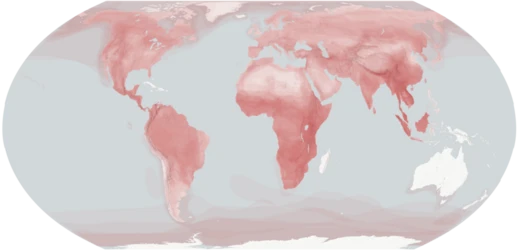
The African civet (Civettictis civetta) is a large viverrid native to sub-Saharan Africa, where it is considered common and widely distributed in woodlands and secondary forests. In some countries, it is threatened by hunting, and wild-caught individuals are kept for producing civetone for the perfume industry. It is the only living member of the genus Civettictis.
- Scientific name
- Civettictis civetta
- Average weight
- 11 to 15 kg (range 7 to 20 kg)
- Head-and-body length
- 67–84 cm
- Tail length
- 34–47 cm
Lore & Background
civetta as its only species. Several subspecies were later proposed in the 20th century, including C. c. congica, C. c. schwarzi, C. c. australis, C. c. volkmanni, and C. c. pauli.
Reader's Guide
The African civet is significant as the only living member of the genus Civettictis and the largest viverrid in Africa. Its perineal glands produce civetone, a substance used in the perfume industry, which has led to the capture of wild individuals in some countries. The species is primarily nocturnal and solitary, using scent marking and latrines (civetries) for communication and territory defense. Its omnivorous diet includes small vertebrates, invertebrates, eggs, carrion, and vegetable matter, and it is one of the few carnivores capable of eating toxic invertebrates such as termites and millipedes. The African civet's role in seed dispersal through its latrines is still being researched. Phylogenetic studies show it is closely related to the genus Viverra, with the split estimated at 12.3 million years ago.
Did You Know?
- The African civet is one of the few carnivores capable of eating toxic invertebrates such as termites and millipedes.
- Its perineal glands are larger in males and are used to produce civetone for the perfume industry.
- African civets deposit feces in large piles called latrines or 'civetries,' which may aid seed dispersal.
Taxonomy and a Tangle of Names
The word civet conceals a remarkably loose grouping. It lumps together more than a dozen species that do not share a single common ancestor, stretching across the Viverridae family as well as the unrelated Eupleridae and Nandiniidae. The Malagasy civet and the African palm civet, for instance, are not true civets at all, yet the popular label covers them. The species most historically tied to the name is Civettictis civetta, the African civet. In everyday English people call these animals civet cats, but they are not felines. Across South and Southeast Asia the naming grows even more layered: musang in Malay and Indonesian, urulǣvā in Sinhalese, khatash and bagdash in Bengali, zohamola in Assamese (a term that literally references their aromatic feces), and veruk in Malayalam. Sri Lanka's golden palm civet was recently divided into three separate endemic species. Adding to the confusion, Malay-language print media has at times misapplied musang to foxes rather than using the correct, less familiar word rubah.
Physical Form and the Musk Trade
Civets carry a broadly feline silhouette, yet their elongated, pointed muzzle distinguishes them, evoking otters, mongooses, or ferrets rather than true cats. Body length, measured without the tail, spans roughly 43 to 71 centimeters, and weight ranges from about 1.4 to 4.5 kilograms. The feature of greatest commercial interest is the musk secreted by perineal glands, a substance produced by both males and females. The African civet has long been the principal source of this fragrant material, which perfumers value both for its scent and its role as a stabilizing agent in formulations. Historically, harvesters killed the animal and removed the glands outright; the preferred contemporary method instead scrapes secretions from a living individual. Even so, welfare organizations such as World Animal Protection have voiced serious alarm over the cruelty involved. Combined with the growing availability of synthetic alternatives, the practice of keeping civets specifically for musk is now in steep decline.
Diet and the Kopi Luwak Phenomenon
Among feliforms and carnivores broadly, civets are striking outliers as omnivores or even near-herbivores. Many species rely primarily on fruit, and some draw a significant share of their energy from flower nectar. As human settlements creep into their range, civets increasingly raid livestock and smaller domesticated animals, including poultry, ducks, rabbits, and cats. No aspect of their biology, however, has captured global attention quite like the production of kopi luwak, a coffee made from cherries consumed and partially digested by the Asian palm civet. Stomach enzymes alter the beans during passage, lending the finished brew a distinctive aroma and flavor that commands extraordinary prices—up to six hundred dollars per half-kilogram in some markets, or around one hundred dollars per cup elsewhere. That demand has spawned civet farms where animals are fed almost exclusively coffee cherries, leading to severe malnutrition. The conditions on these operations are widely characterized as appalling, and regulatory oversight in the Philippines and Vietnam is essentially absent.
Range, Habitat, and Conservation Pressures
Viverrid civets are native to a wide swath of the Old World, stretching from sub-Saharan Africa and Madagascar through the Iberian Peninsula, southern China, and across South and Southeast Asia. They favor woodland, savanna, and mountainous biomes, and the greatest concentration of species diversity is found in Southeast Asia. Yet this broad distribution masks serious vulnerability. Habitat loss is severe across the range, pushing several species onto vulnerable lists; the otter civet is classified as endangered. Some civets are so rare and elusive that almost nothing is known about them—Hose's civet, confined to the montane forests of northern Borneo, is regarded as one of the world's least-studied carnivores. In Bangladesh the animal has become extremely rare, surviving in pockets such as the Khulna region where locals call it shairel. The intersection of expanding human habitation, habitat fragmentation, and the lingering legacy of the musk and coffee trades places many of these small, slender, largely nocturnal mammals at genuine risk.
Frequently Asked Questions
Who is African civet?
African civet is a large, solitary viverrid native to sub-Saharan Africa and the sole surviving species in the genus Civettictis. It typically weighs between 11 and 15 kilograms and measures roughly 67 to 84 cm from head to body, with a tail adding another 34 to 47 cm.
What are African civet's powers/role?
Its most distinctive trait is the secretion of civetone, a fragrant compound that has made the animal prized by the perfume industry. As a nocturnal hunter, it operates alone through woodlands and secondary forests, preying on small animals under cover of darkness.
Where does African civet live?
It ranges widely across sub-Saharan Africa, favoring woodland habitats and secondary forests. In most of its distribution it is regarded as common, though local populations in certain countries face pressure from hunting and trapping.
How does African civet's story end?
In several parts of its range, continued hunting and the capture of wild individuals for civetone extraction place ongoing pressure on local groups. Despite these threats, the species as a whole remains broadly distributed and is not currently listed as endangered.
Why is African civet important?
As the only living member of its genus, it carries unique evolutionary significance within the viverrid family. It also serves as a nocturnal predator in forest ecosystems and holds economic and cultural value because of its civetone production.
More in Carnivorans 1-21
Spotted an error? Know more?
This is a living reference — every entry is fact-audited, and reader corrections feed straight into our audit queue. Suggest an edit · See this site's audit record