Bush dog
Rare South American canid with pack behavior and webbed toes.

The bush dog (Speothos venaticus) is a rare canine found in Central and South America, first described from fossils in Brazilian caves and initially believed extinct. It is the only extant species in the genus Speothos, with genetic evidence suggesting its closest living relative is the maned wolf or the African wild dog. Listed as Near Threatened by the IUCN, it is notable for its social pack behavior, partially webbed toes for swimming, and unique dental adaptations among American canids.
- Scientific name
- Speothos venaticus
- Conservation status
- Near Threatened
- Average weight
- 5–8 kg (11–18 lb)
- Head-body length
- 57–75 cm (22–30 in)
- Shoulder height
- 20–30 cm (8–12 in)
- Lifespan in captivity
- Up to 10 years
- Diploid chromosome number
- 74
Lore & Background
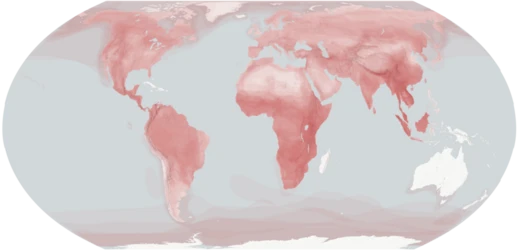
Living individuals were later discovered, and the species is now known to range from Costa Rica through much of South America east of the Andes, as far south as central Bolivia, Paraguay, and southern Brazil. It primarily inhabits lowland forests, wet savannas, and habitats near rivers, though it may also be found in drier cerrado and open pasture. Bush dogs are carnivores that hunt during the day, typically preying on large rodents such as pacas, agoutis, and capybaras. They often hunt in small packs, using coordinated tactics—for example, part of the pack chases prey on land while others wait in the water. Packs consist of a single mated pair and their immediate relations, with only the adult pair breeding while other members help rear pups. They communicate with frequent whines, likely due to poor visibility in the undergrowth where they hunt. Reproduction occurs throughout the year, with gestation lasting 65 to 83 days and litters of three to six pups (up to ten reported). Young are born blind and helpless, opening their eyes after 14 to 19 days, and reach sexual maturity at one year. Bush dogs have partially webbed toes for efficient swimming and large scent glands on either side of the anus. Their dental formula is unique among American canids: 3.1.4.1/3.1.4.2, totaling 38 teeth.
Reader's Guide
The bush dog is significant as one of the least-studied canines, with conservation efforts still in early stages. Its rarity and elusive nature have made it difficult to study; traditional camera traps have proven ineffective, leading researchers to use scent-detection dogs to locate burrows. The species is listed as Near Threatened by the IUCN, with an estimated population decline of 20–25% over the past 12 years. Primary threats include habitat loss from deforestation for wood, cattle farming, and palm oil production, as well as loss of prey due to human hunting and diseases from domestic dogs. Hunting bush dogs is illegal in most of their range, including Colombia, Ecuador, Brazil, French Guiana, Paraguay, Peru, Bolivia, Panama, and Argentina, though Guyana and Suriname lack explicit bans. Enforcement of wildlife laws is limited in many countries. Protected areas such as the Yasuni Biosphere Reserve may support stable populations. This may indicate that with dedicated conservation efforts, bush dog populations could stabilize or increase.
Did You Know?
- The bush dog was first described from fossils in Brazilian caves and was initially believed to be extinct.
- It is one of three canid species (along with the dhole and African wild dog) with trenchant heel dentition, having a single cusp on the talonid of the lower carnassial tooth.
- Bush dogs have partially webbed toes, which allow them to swim more efficiently.
- A pack of six bush dogs has been reported hunting a South American tapir for three hours, biting its legs until it was felled.
Frequently Asked Questions
Who is Bush dog?
The bush dog (Speothos venaticus) is a small, secretive wild canid native to the forests of Central and South America. It is the only surviving species in the genus Speothos and one of the least well-known dog species on the continent.
What makes Bush dog unique among canids?
Unlike most New World canids, bush dogs live in coordinated packs and hunt cooperatively. They also possess partially webbed toes that help them swim, a trait not found in other American dogs.
Where does Bush dog live and how big is it?
Bush dogs range from Mexico through Central America into northern South America, favoring dense forest and swampy habitats. Adults weigh roughly 5 to 8 kilograms and stand about 20 to 30 centimeters at the shoulder.
What is Bush dog's conservation status?
The IUCN classifies the species as Near Threatened, largely because of habitat loss and its already limited, fragmented range. Its secretive pack lifestyle and low population density make it especially vulnerable to deforestation and hunting pressure.
How is Bush dog related to other canids?
Genetic studies point to either the maned wolf or the African wild dog as its closest living relative, though the exact lineage is still debated. This makes it a fascinating evolutionary link between South American and Old World canid lineages.
More in Carnivorans 1-21
Spotted an error? Know more?
This is a living reference — every entry is fact-audited, and reader corrections feed straight into our audit queue. Suggest an edit · See this site's audit record