African palm civet
Sole member of superfamily Nandinioidea; most genetically isolated carnivoran.

The African palm civet (Nandinia binotata), also known as the two-spotted palm civet, is a small feliform mammal widely distributed in sub-Saharan Africa. It is listed as least concern on the IUCN Red List and is the sole member of the superfamily Nandinioidea, making it the most genetically isolated carnivoran.
- field
- Mammalogy
- known_for
- Most genetically isolated carnivoran; sole member of superfamily Nandinioidea
- conservation_status
- Least Concern (IUCN Red List)
- body_length_female
- 37–61 cm
- body_length_male
- 39.8–62.5 cm
- weight_female
- 1.2–2.7 kg
- weight_male
- 1.3–3 kg
Lore & Background
Morphological and molecular analyses show it diverged from Feliformia about 44.5 million years ago. This nocturnal, arboreal mammal spends most of its time in tree canopies, feeding on fruits such as those of the African corkwood tree, Uapaca, persimmon, fig trees, papayas, and bananas. Females give birth after a gestation of 2–3 months, with litters of up to four young suckled for about three months; the female's mammary glands produce an orange-yellow liquid that discolors her abdomen and the young's fur, likely discouraging males from mating with nursing females.
Reader's Guide
The African palm civet holds unique evolutionary significance as the sole member of the superfamily Nandinioidea and the most genetically isolated carnivoran, having diverged from other feliforms approximately 44.5 million years ago. Its distinct ear canal structure—undivided and cartilaginous at the end—supports its taxonomic separation from viverrids. Despite its wide distribution, it faces threats from habitat loss and hunting for bushmeat, with significant numbers taken annually in Nigeria and Cameroon. In some regions, it is used in animal rituals, and in Ghana, rural attitudes are hostile due to perceived threats to food resources and child safety. Its presence on Bioko Island was recorded in the 1950s but not in later surveys, suggesting possible local extirpation. Conservation efforts must address ongoing habitat fragmentation from logging, mining, and agricultural conversion, including oil palm plantations.
Did You Know?
- The African palm civet is the sole member of the superfamily Nandinioidea and the most genetically isolated carnivoran.
- It has two sets of scent glands: on the lower abdomen and between the third and fourth toes on each foot.
- Females give birth after a gestation of 2–3 months, and their mammary glands produce an orange-yellow liquid while suckling.
- In Gabon, it is among the most frequently found small carnivores for sale in bushmeat markets.
A Lineage Apart: Evolutionary Isolation
The African palm civet occupies a singular position in the tree of carnivorous mammals. It is the only living species within its entire superfamily, Nandinioidea, making it the most genetically isolated member of the order Carnivora. Molecular and morphological evidence confirms that it diverged from the broader Feliformia lineage roughly 44.5 million years ago, a separation so ancient that it shares little structural or genetic common ground with its nearest relatives, the viverrids. Fourteen years later, Gray himself erected the genus Nandinia to house it. Today, no other species shares that family, that superfamily, or that deep evolutionary branch.
Form, Scent, and the Language of the Body
The African palm civet presents a compact, lean silhouette: short legs, small ears, and a long, ringed tail that can exceed the body length in some individuals. Its coat ranges from grey to dark brown, broken by dark spots across the back. Males measure roughly 40 to 62.5 cm in body length with tails reaching up to 76 cm and a mass of 1.3 to 3 kg, while females are slightly smaller at 37 to 61 cm body length, 34 to 70 cm tail, and 1.2 to 2.7 kg. One of the most striking anatomical details is the ear canal, which remains undivided and ends in cartilage—a trait that helped early taxonomists separate this lineage from other feliforms. Equally remarkable is its chemical communication system. Two sets of scent glands, one on the lower abdomen and another between the third and fourth toes of each foot, produce a potent secretion the civet uses to delineate territory and signal readiness to mate. In this way, the animal's very body becomes a medium for social interaction in the dense understory and canopy where visual cues are limited.
Canopy Life and the Rhythms of Reproduction
Nocturnal by nature and largely arboreal in habit, the African palm civet spends its waking hours perched on large branches and threading through lianas high in the forest canopy. Its diet is overwhelmingly frugivorous, drawing on African corkwood, Uapaca, persimmon, fig, papaya, and banana fruits. In Gabon, birth timing clusters around the long wet season and the early dry season, roughly September through January, following a gestation of two to three months. Litters of up to four young are nursed for approximately three months. During this period, the mother's mammary glands secrete an orange-yellow liquid that stains her belly and the kits' fur—a conspicuous marking that likely deters males from attempting to mate with a nursing female. The species' generation length stands at 7.8 years, a moderate pace that shapes how quickly the population can respond to environmental change.
Pressures on a Widespread but Vulnerable Species
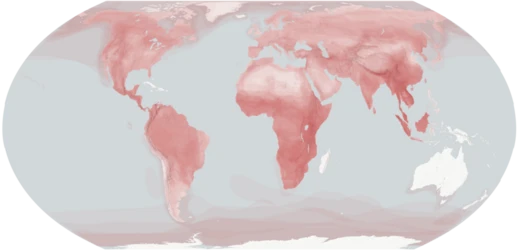
Despite its broad range across sub-Saharan Africa—from Guinea and South Sudan in the north to Angola and eastern Zimbabwe in the south—and its least-concern status on the IUCN Red List, the African palm civet faces mounting pressures. In Ghana, rural communities view the civet with hostility, seeing it as a threat to stored food and even to children's safety. In Gabon, it ranks among the most commonly sold small carnivores in bushmeat markets. Habitat fragmentation compounds these threats: Liberia's Upper Guinean forests have already been split into two blocks, and large areas face conversion through logging, mining, and industrial oil palm plantations.
Frequently Asked Questions
Who is African palm civet?
African palm civet (Nandinia binotata), often called the two-spotted palm civet, is a small feliform mammal found across sub-Saharan Africa. It is the only living species in the superfamily Nandinioidea, setting it apart from every other carnivoran.
What are African palm civet's powers/role?
Its standout trait is extreme genetic isolation: it is the most genetically distant carnivoran from all others, having branched off so long ago that it forms its own superfamily with no close relatives. In the carnivore family tree, it essentially stands alone as a one-of-a-kind lineage.
How does African palm civet's story end?
Its current arc is stable— the IUCN Red List classifies it as Least Concern, meaning its wide sub-Saharan range keeps it safe from near-term extinction threats. No major conservation crisis currently threatens the species.
Why is African palm civet important?
Because it is the sole surviving member of Nandinioidea, it represents an ancient evolutionary branch of carnivorans with no other living representatives. Studying it gives scientists a rare window into early carnivore diversification and deep genetic history.
What are African palm civet's base stats?
Females measure roughly 37–61 cm in body length and weigh 1.2–2.7 kg, while males range from about 39.8–62.5 cm and sit at the upper end of that weight band. It is a compact, small-bodied mammal compared to larger civet relatives.
More in Carnivorans 1-21
Spotted an error? Know more?
This is a living reference — every entry is fact-audited, and reader corrections feed straight into our audit queue. Suggest an edit · See this site's audit record